By symptom
Chest Pain: When to Go to the ER, and When to Call 911 Instead
Published August 16, 2026 · 6 min read
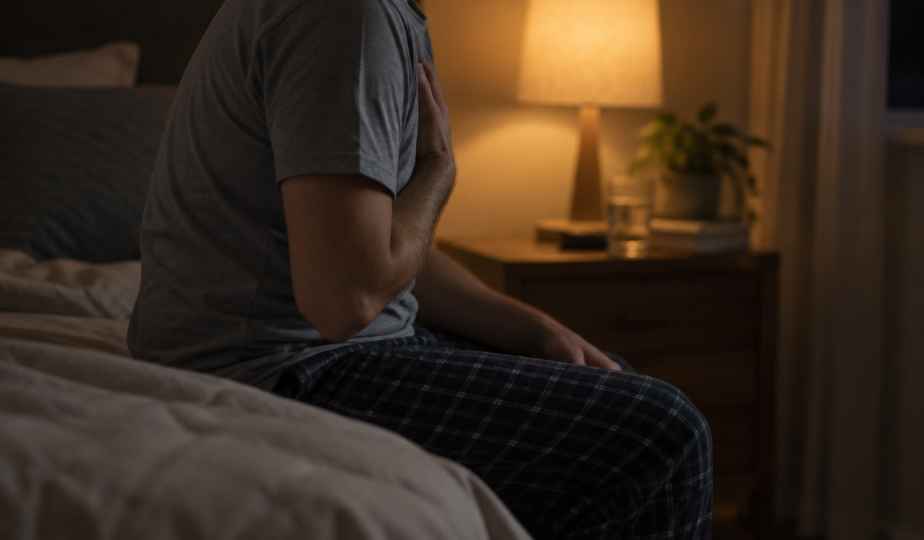
If you are having chest pain right now and it is severe, came on suddenly, or
comes with shortness of breath, sweating, nausea, or pain spreading to your arm,
jaw or back — call 911. Do not drive yourself, and do not wait to see whether it
passes.
Everything below is for people who have a moment to read. If you do not, you
already have your answer.
Call 911, do not drive
Severe or sudden chest pain, or pain with breathlessness, sweating, nausea, or spreading to arm or jaw.
Do not wait to see if it passes
If you are reading this while it is happening, you already have your answer.
If you are unsure, come in
This list is not exhaustive and you are not expected to diagnose yourself.
Why "call 911" and not "come in"
This is an emergency room and we would rather you came here than nowhere. But
for possible heart attack, an ambulance is better than your car, and it is
worth understanding why rather than taking it on trust:
- Treatment starts on the way. Paramedics can run an ECG in your driveway
and begin treatment in the vehicle. That time is not recoverable later. - They radio ahead. The team knows what is coming and prepares for it.
- If your heart stops, you want to be with them and not behind the wheel.
The most dangerous hours of a heart attack are the earliest ones, and cardiac
arrest while driving endangers you and everybody else on El Mirage Road.
Driving a person with chest pain to hospital is one of the most common
well-meant mistakes there is. If someone near you has these symptoms, call
911 and stay with them.
The symptoms people recognise
Most people picture crushing central chest pain, and that is real:
- Pressure, tightness, squeezing or heaviness in the centre or left of the
chest - Pain spreading to one or both arms, the shoulders, neck, jaw, or back
- Shortness of breath, with or without chest pain
- Cold sweat, clamminess
- Nausea or vomiting
- Light-headedness or a feeling of impending doom
It does not have to be severe to be serious. People routinely describe a
heart attack afterwards as "not that bad at the time" — an ache, a pressure, an
indigestion feeling that would not settle. Pain you can talk through is still
worth acting on.
The symptoms people miss
This is the part of the article worth reading before you need it.
Heart attacks do not always announce themselves as chest pain, and some
groups are considerably more likely to present without it:
- Women more often have shortness of breath, nausea or vomiting, back or jaw
pain, and unusual fatigue — sometimes with no chest discomfort at all. - People with diabetes may feel much less pain than expected, because
nerve damage blunts the signal. - Older adults may show confusion, weakness, fainting or breathlessness
rather than pain.
Unexplained, sudden, severe fatigue or breathlessness — especially with
sweating or nausea — deserves the same response as chest pain. If something
feels badly wrong and you cannot account for it, that is a reason to act, not a
reason to wait for a more recognisable symptom.
Things that are not your heart — and why that does not settle it
Chest pain has many causes that are not cardiac: acid reflux, a strained muscle,
anxiety, a rib injury, pneumonia, a chest infection, a blood clot in the lung.
Some of those are harmless and some are emergencies in their own right.
The catch is that you cannot reliably tell them apart yourself, and neither
can we without testing. Reflux and a heart attack genuinely feel alike to a
great many people. That is not a failure of attention — it is anatomy.
So the question is never "is this definitely my heart?" It is "does this need
ruling out?" Ruling it out takes an ECG and a blood test, and it takes about
as long as reading this page.
What happens when you arrive here
Chest pain is triaged as urgent. You are not going to sit in a waiting room with
a number.
- An ECG is among the first things done — it is what tells us whether this
is happening right now. - Blood tests for cardiac markers, run in our own laboratory, so results
come back during your visit rather than after a transfer. - A physician sees you — board-certified, every visit, at every hour.
- CT and X-ray on site, and ultrasound called in from a mobile service, if the
answer points somewhere other than your heart, which it often does. - A critical care room in this building for the presentations that need one.
And if it is your heart, or you need admission, we stabilise you here and
arrange the transfer to a hospital. We are a freestanding emergency room, not
a hospital — that is worth knowing before you arrive rather than during a
difficult evening.
Some visits sit in between: not clearly cardiac, not clearly safe to send home.
We can hold and monitor you here for up to 24 hours, repeat the blood test,
and make the decision with more information than a single snapshot gives.
The cost question, answered honestly
People delay going in because they are afraid of the bill. It is worth saying
plainly:
We do not balance bill, ever, for any patient. You will never pay more than
your in-network deductible and coinsurance here, whoever insures you. If you
have no insurance, you are assessed and screened all the same — what you can pay
never decides your care — and there are payment plans.
And the blunt version: chest pain is the wrong thing to weigh against cost.
An emergency room visit bills at emergency rates, and if you have a sore throat
an urgent care is cheaper and better. A heart attack you waited out is not
cheaper than anything. How our billing works.
What not to do
- Do not drive yourself. Call 911.
- Do not wait for it to pass. The instinct to give it twenty minutes is the
single most common reason people arrive too late. - Do not take someone else's heart medication, and do not take medication a
webpage suggested, including over-the-counter tablets. If you call 911, the
dispatcher can ask you the questions that decide whether anything is safe for
you — a webpage cannot. - Do not talk yourself out of it because you are young, fit, or "not the
type". Nobody is the type. - Do not go to an urgent care with chest pain. They will send you to an
emergency room, and you will have spent the time twice.
ER or urgent care
El Mirage ER — open 24 hours a day, 7 days a week, 365 days a year.
12000 N El Mirage Rd, El Mirage, AZ 85335 · (480) 237-4922
Walk in. No appointment, no referral.
If this is a medical emergency, call 911.
This article explains when to seek emergency care. It is not medical advice and
cannot account for your history, your medications, or what is happening to you
now. If you are unsure, call us or call 911.
Sources
The guidance in this article about when to seek emergency care is drawn
from these public sources. Each one is linked so you can read it yourself.
- MedlinePlus (National Library of Medicine) — Heart Attack — https://medlineplus.gov/heartattack.html
This article is general information, not a diagnosis, and it cannot account
for your history or medications. If you are unsure, call us on (480) 237-4922
or come in. If it might be an emergency, treat it as one and call 911.