Open now — 24/7, holidays included
12000 N El Mirage Rd, El Mirage AZ
Billing (480) 339-4825
Billing
Billing & Insurance — El Mirage ER
Three things worth knowing before you read anything else.
An Explanation of Benefits is not a bill. If an envelope or an email arrives from your insurance company after your visit, it is almost certainly an EOB — a statement of what they paid. It is not a demand for money.
We do not balance bill. Ever. Not for any patient, whatever insurance you carry, and not when your insurer pays us less than we billed.
You will never pay more than your in-network deductible and coinsurance here — regardless of which insurer you are with.
If something arrives that you do not understand, call the billing team on (480) 339-4825 and ask. That is what they are there for, and asking is free.

An EOB is not a bill
A statement of what your insurer paid, not a demand.
We never balance bill
Not for any patient, whatever insurance you carry.
Payment never decides care
Screening and treatment are never conditioned on what you can pay.
Out of network, and why that does not cost you more
This is the part most freestanding emergency rooms leave for the small print, so here it is in plain sight: El Mirage ER is out of network with all insurance plans. We bill every insurer, and we accept fair payment from them.
Out of network normally means a bigger bill. For emergency care it does not, for three separate reasons — and any one of them would be enough:
1
Federal protections for emergency care
People with most commercial and employer health plans are protected from surprise balance bills for emergency services, with cost-sharing calculated at in-network rates. CMS sets out those rights in plain language: Understand your rights against surprise medical bills.
2
Arizona's own rules, and the “prudent layperson” test
Coverage for emergency care does not turn on whether it was an emergency — the test is whether a reasonable person would have thought so. You are not penalised for coming in and being fine. Arizona's regulator explains what your plan must cover and how to challenge it: DIFI — health insurance and the appeals process.
3
Our own policy, which is broader than either
We do not balance bill any patient for any service we provide, whoever insures them. Those first two protections do not reach everybody. This one does.
So when an EOB turns up using severe language about your care being out of network — and they do — the sentence that matters is that your insurer is required to pay a fair rate for an emergency visit, and that we will not come after you for the difference.
What you will actually pay
If a deductible makes that hard, say so. We will set up a payment plan or other reasonable arrangement for what you owe the facility — that is a standing commitment, not a favour you have to negotiate for.

Two claims, one visit
Your visit generates two separate bills: one from the facility and one from the physician who treated you. Both go to your insurance company. This is normal and it is how emergency care is billed everywhere — but nobody tells you in advance, so two envelopes feel like being charged twice.
You are not being charged twice.

One from the facility
The building, the imaging, the laboratory, the nursing care.
One from the physician
The doctor who treated you bills separately. This is standard everywhere.
Neither is a second charge
If two envelopes arrive and you are unsure, call before you pay anything.
No insurance?
You are welcome here, and the care comes first. Everyone who arrives is assessed and receives an emergency medical screening — whatever you can pay. Ask about cost at any point; most people paying for themselves do, while they wait. There is a cash-pay form to fill in and sign, and that also happens while you wait — being seen never waits on it.
We take cash, cheque and credit card. Pricing depends on what your condition turns out to need, so ask the billing team — and if you need financial assistance, help understanding a bill, or a payment arrangement, that is a conversation they have every day. Call (480) 339-4825.
If your insurer refuses to pay
A refusal is not the end of it, and you should not assume the bill becomes yours. There is a route, and it works:
1. Appeal with your insurer first. Arizona's regulator will generally require you to have gone through your health plan's own appeals process before it takes up the complaint, so starting there is not a delay — it is the first required step.
2. Then take it to the state. Complaints go to the Arizona Department of Insurance and Financial Institutions (DIFI), whose complaint form and current contact details are on its own site. DIFI also publishes a plain-language Consumer Guide to the Health Care Appeals Process.
3. Call us. We would rather help you fight a denial than have you assume the bill is yours. (480) 339-4825.
If a cheque arrives addressed to you
Because we are out of network, some insurers send payment to the member rather than to us. If a cheque from your insurance company for your ER visit arrives in your name, it is our payment and you are responsible for forwarding it to us or to our billing company.
If you are not sure whether what you have received is a payment, an EOB or a bill, call (480) 339-4825 and read it to us. That is the fastest way to settle it.

Workers' compensation
Yes, we accept workers' compensation. If you were hurt at work, your employer's workers' compensation coverage — rather than your own health plan — is normally what pays for the visit, and fault is usually not the deciding factor.
There is a filing deadline, so do not sit on it. The Industrial Commission of Arizona, Claims Division sets out who is covered, what the deadline is and how to file — and it is the right place for questions about your claim, as opposed to your treatment, which is ours.
If you have Medicare

Yes, we see Medicare patients. Come in.
We are not in Medicare's network. That sounds like it should cost you more. It does not, and the reason is worth two sentences.
You are examined and stabilised whatever your insurance and whatever you can pay. That is not a courtesy we extend when it suits us — it is written into the consent form you sign at the desk, which states that medical screening and stabilizing treatment are never conditioned on payment. It is why “are you in network?” is the wrong question to ask before an emergency.
Then a second federal law does the rest. Under the No Surprises Act, your share of an emergency bill is limited to what you would have paid in network — your ordinary copay, coinsurance and deductible, and nothing beyond it. We do not bill you for the difference. Not for Medicare patients, not for anyone.
So the bill you receive here should not be larger than the bill you would have received at an in-network emergency room. If one ever looks larger, that is a reason to call us, not a reason to pay it.
What to bring: your Medicare card, and any secondary or supplement plan card if you have one. If you do not have them with you, come anyway — we sort the paperwork out afterwards, and nobody is turned away for arriving without a card.
One thing we cannot do: tell you in advance exactly what your plan will pay. That is between you and Medicare, and it depends on your deductible and what else you have used this year. What we can tell you is that we will not add to it.
Medicaid, VA and Indian Health Service
Come in. The same federal obligation to examine and stabilise applies whatever your coverage, and the same rule against balance billing applies to your emergency care.
Beyond that, we are not going to publish specifics we cannot stand behind. Coverage under AHCCCS, VA community care and IHS purchased/referred care each work differently, they change, and a confident sentence here that turns out to be wrong costs a patient money. Call our billing team on (480) 339-4825 and ask about your specific plan — that answer will be current and it will be about you.
Paying a bill
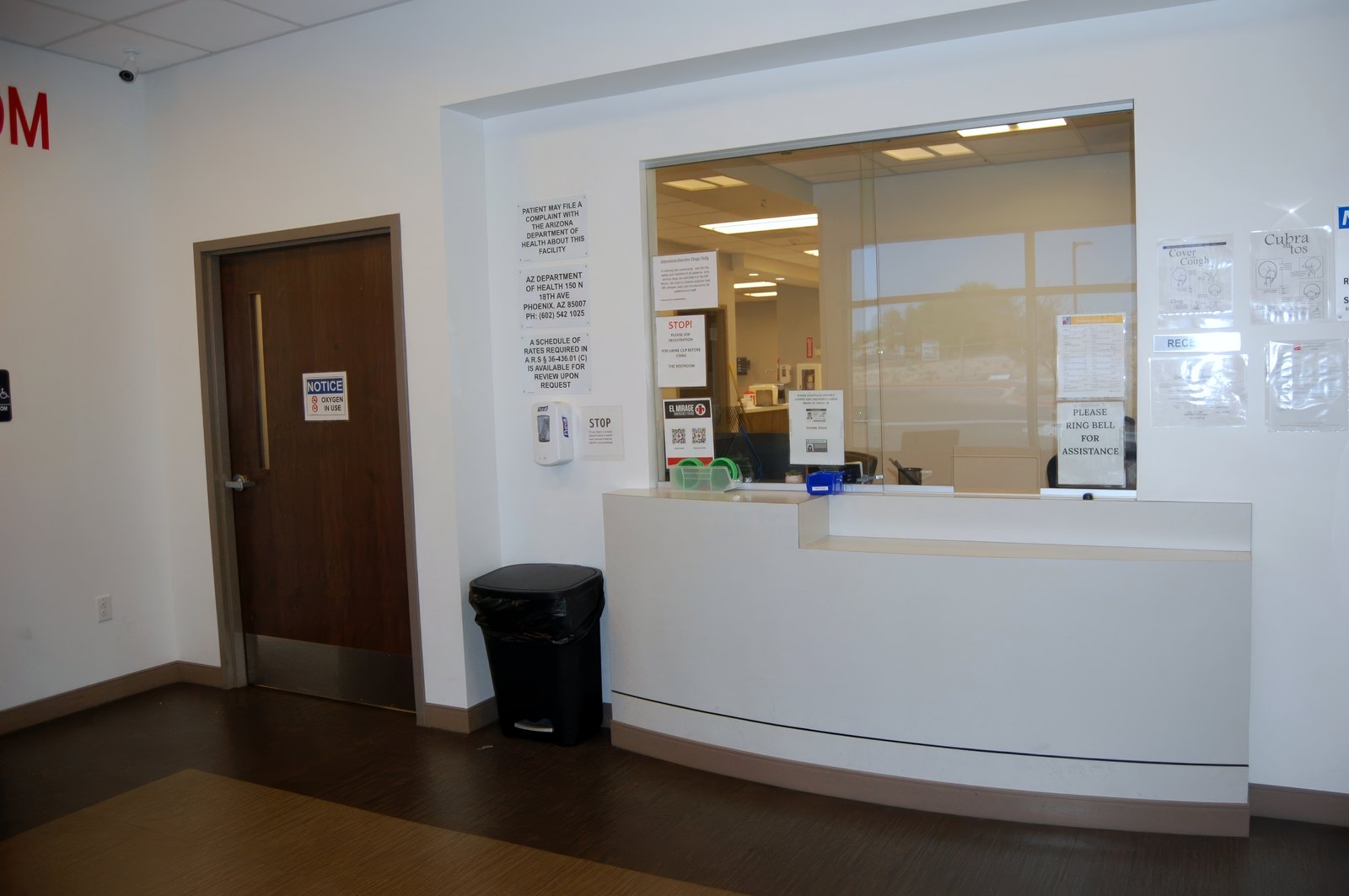
This is the desk, and nothing that happens at it decides your care. Cost questions and registration paperwork happen here — often while you wait to be seen — and treatment does not wait on either.
Pay online: the payment portal is PayStatementOnline — a third-party service, so you will be leaving this website.
Pay or ask by phone: (480) 339-4825, Monday to Friday.
Still not sure whether you owe anything? Call before you pay. An EOB is not a bill, and we would rather answer the question than take money you do not owe.
In partnership with HealthPass
The bill is the part people dread. This is what we did about it.
HealthPass is a healthcare membership — not insurance. It pays the copays, deductibles and coinsurance your insurer assigns for eligible visits to this emergency room, and it applies to visits you have already had, not only the ones ahead of you.
Visits already behind you
An eligible visit you have already made can be paid for. That is unusual, and it is the part worth knowing if a bill has already arrived.
The visit in front of you
Come in first and sort the money afterwards. Nobody is turned away, and no cost question is settled at the door.
And the ones after that
Membership keeps paying those costs for future eligible visits here, so the next emergency is not also a calculation.
HealthPass is a separate company and it is not insurance. It is a membership that works alongside the insurance you already have — never in place of it. You do not need it to be seen here; our doors work the same either way. What it covers, the price and the sign-up all live on their own site, because the product should make its own claims.
Join HealthPass ↗Opens our partner's site in a new tab.
El Mirage ER — open 24 hours a day, 7 days a week.
12000 N El Mirage Rd, El Mirage, AZ 85335 · Main (480) 237-4922 · Billing (480) 339-4825
If this is a medical emergency, call 911.
About your bill, before you worry about it
If something arrives from your insurance company after your visit, it is almost certainly not a bill. It is an Explanation of Benefits — a statement of what they paid. The large number on it is not what you owe.
For emergency care, federal law limits your share to the ordinary in-network copay, coinsurance and deductible your plan already sets. We do not bill you for the difference, and we never will.
If anything you receive is unclear, call us before you pay it. Our billing team would rather explain a statement than have you pay something you do not owe.